


Panama’s airports and airstrips, from international hubs to small coastal runways.

Choose your route and we’ll help you arrange the best private charter for your trip.

Panama, Faster. Better. Smarter.
Why Panama Charter Flights?
Panama is a small country with big distances when you travel by road. A drive from Panama City to the Pacific or Caribbean coasts can take 6–9 hours with traffic, construction, and winding mountain roads. With a charter flight, you can be on the beach, in the water, or on a boat in under an hour.
Charter flights are the ultimate travel hack in Panama if you want to:
-
Maximize your vacation time
-
Reach remote islands and surf breaks
-
Connect multiple destinations in one trip
-
Travel privately, comfortably, and on your own schedule
From surf trips to Santa Catalina, diving in Coiba, island-hopping in Bocas del Toro, or fishing in Piña Bay, charter flights make Panama feel smaller, faster, and easier to explore.




FAQ - Panama Charter Flights
Panama Charter Flights is an independent guide and planning platform focused on charter flights within Panama. We don’t operate aircraft ourselves. Instead, we help you understand which airports and airstrips exist, which routes make sense to fly, what types of aircraft are used and how pricing usually works. When you send a flight request through our forms, we use your details to help you compare options from licensed operators and organize the logistics of your trip.
Charter flights in Panama can connect almost every region of the country. Common routes link Panama City (Tocumen, Albrook or Panama Pacífico) with destinations like Bocas del Toro, Santa Catalina and Coiba region, San Blas (Guna Yala), Pearl Islands, Pedasí and Playa Venao, Las Lajas, Boquete/Chiriquí Highlands and remote parts of Darién. Many of these places also have small community airstrips or private fields where charter aircraft can land, combined with short car or boat transfers.
Charter flights in Panama are operated under the supervision of the Autoridad Aeronáutica Civil (AAC), which regulates airworthiness, flight operations, aerodromes and aviation safety in the country. Licensed operators must comply with these regulations, keep their aircraft maintained and use qualified pilots. That said, charter flights use smaller aircraft than big airlines and are more sensitive to weather, runway conditions and weight limits, so flights may be delayed, rerouted or rescheduled if safety margins are not met.
Most charters in Panama run under VFR (visual flight rules), which normally do not allow operations between sunset and sunrise unless specially authorized by air traffic authorities.
On top of that, Panama is a tropical country where thunderstorms and heavy rain can develop quickly, and general aviation safety guidance recommends avoiding flying in or near thunderstorms because of turbulence, lightning, wind shear and other hazards. For these reasons, charter flights are usually planned within daylight hours and safer weather windows.Charter flights are priced per aircraft, not per seat. The total cost depends mainly on:
-
Distance and flight time
-
Type of aircraft (small single-engine vs. larger turboprop)
-
Number of passengers and total weight
-
Airports and fees involved
As a rough reference, some Panamanian operators list short hops of 30–60 minutes in small aircraft (2–4 passengers) starting around a few hundred to a couple of thousand USD per one-way flight, while larger turboprops that carry 9–12 passengers cost more.
Our goal is not to fix a price table, but to help you understand the factors that drive cost so you can compare quotes intelligently.-
On charter flights, luggage limits are driven by aircraft size and total weight, not just the number of bags. As a rule of thumb on many light aircraft and small charter jets worldwide, operators often allow around 20–23 kg (≈44–50 lb) per passenger for checked bags, plus a small personal item, but this can go up or down depending on the plane and how many people are flying.
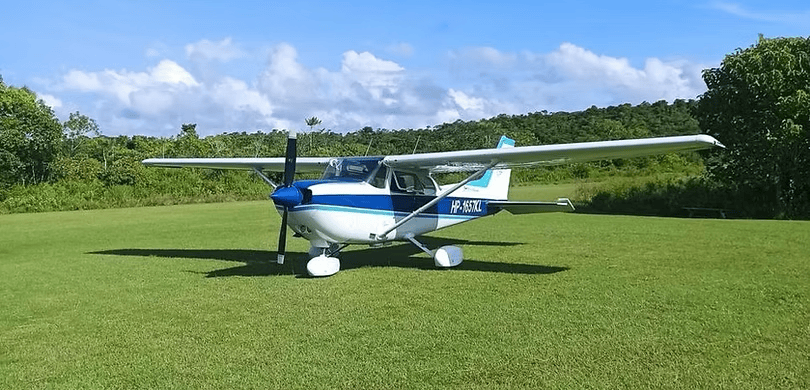
In Panama, small aircraft like Cessna and Piper models also have limited baggage volume, so soft-sided bags are usually better than large hard suitcases. The exact allowance for your flight will be confirmed by the operator based on aircraft, route and passenger weight.To receive useful options instead of vague estimates, it helps to include:
-
Route (from which airport to which airport or destination)
-
Dates and schedule flexibility
-
Number of passengers and approximate weights
-
How much luggage and special gear (surfboards, dive gear, fishing gear, etc.)
-
Purpose of the trip (surf, dive, fishing, business, family, photography…)
With this information, operators can tell you which aircraft are suitable, what weight limits apply, estimated flight time, price range and any ground or boat transfer you should plan.
-